

Description
The documentation of a European research project on digitally fabricated building components made with bio-based materials, involving three university institutes and three industry partners from Denmark, Germany, Italy and Spain. Living Prototypes was instigated by ANCB and supported by the Federal Institute for Research on Building, Urban Affairs and Spatial Development (BBSR) on behalf of the German Ministry for Housing, Urban Development and Building with funds from the research innovation programme Zukunft Bau.
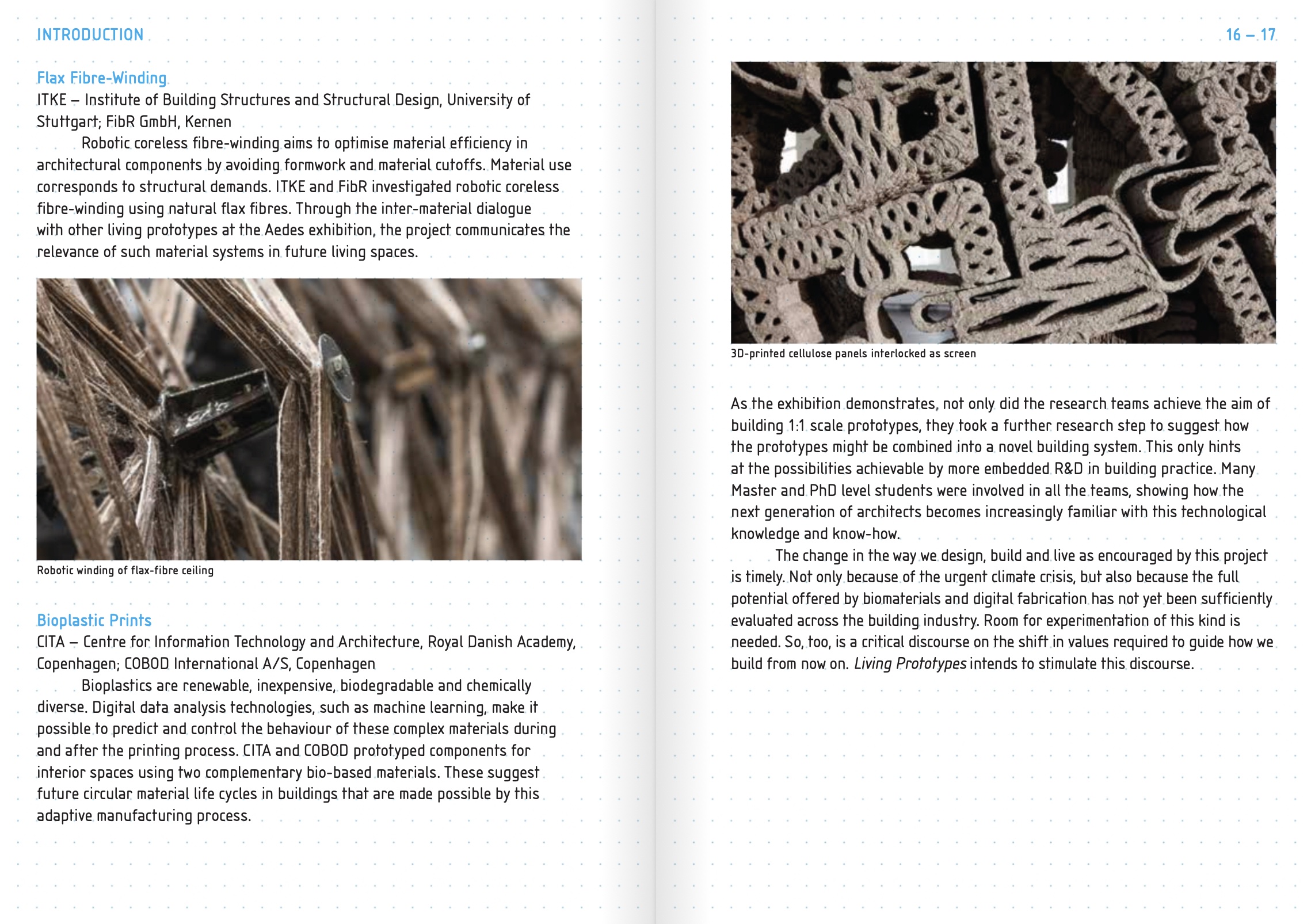
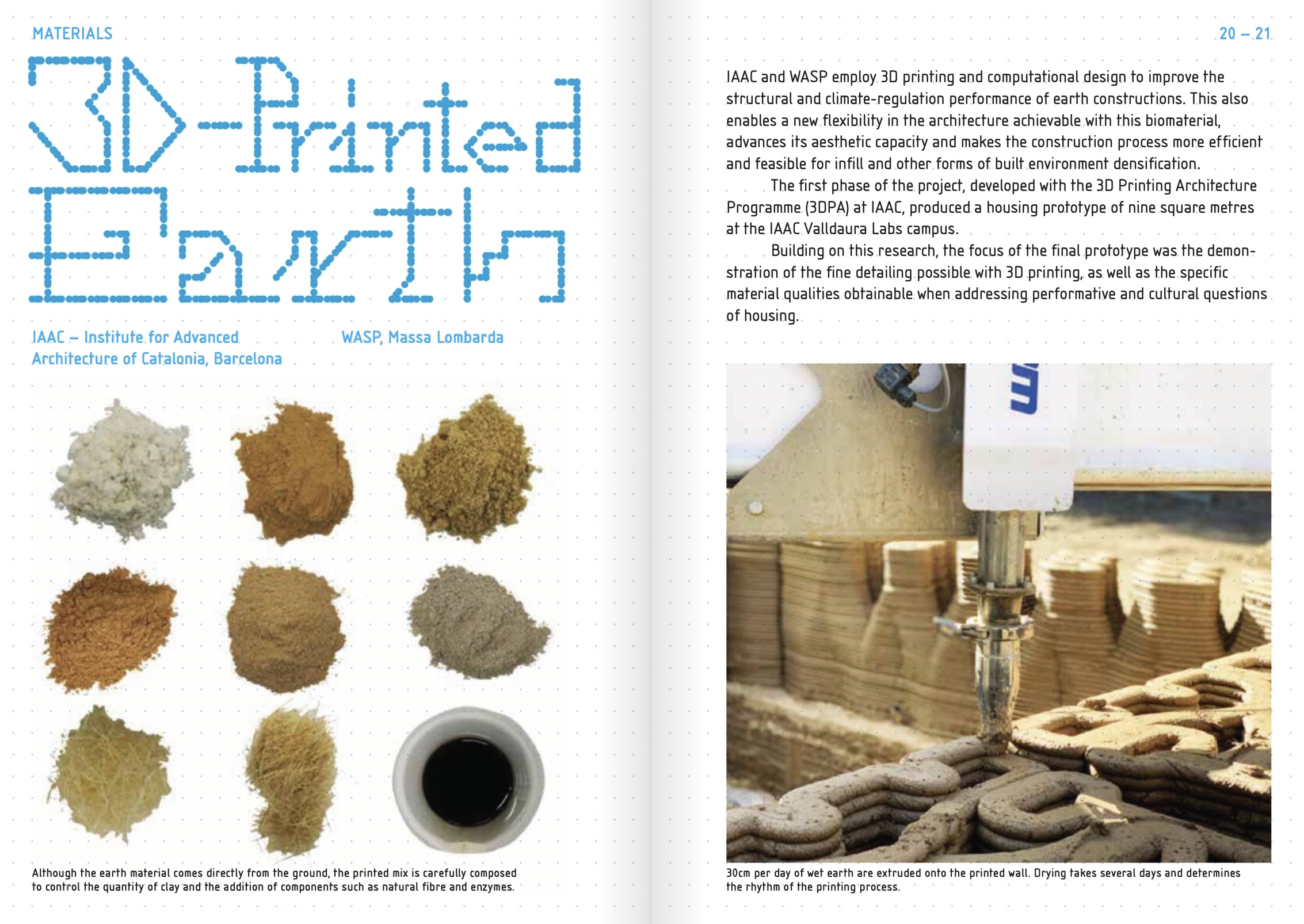
Over the course of 18 months, three university institutes collaborated with three industry partners on digitally fabricating prototypes for building components for living spaces made with the bio-based materials earth, flax fibre and bioplastics.
- IAAC Institute for Advanced Architecture of Catalonia in Barcelona and WASP from Massa Lombarda
- ITKE from the University of Stuttgart and FibR from Kernen
- CITA from the Royal Danish Academy in Copenhagen and COBOD from Copenhagen
In this publication, the ideas and outcomes generated by the Living Prototypes project are collated under the themes of Materials, Prototypes and Visions.
Materials (16–35)
The design of the prototypes connected the process of developing biomaterials from earth, flax and natural cellulose, with the process of crafting these into building components at the 1:1 scale: by exploring how to treat and combine raw materials, identifying the appropriate digital fabrication techniques, and examining how the test results performed structurally, behaviourally and aesthetically.
Prototypes (36–43)
The three separate prototype building components – an earth wall, a cellulose screen, a flax fibre slab – could be integrated as a mini building system, despite having different logics of material and making. Bespoke joint detailing was fluently incorporated as an iterative refinement of the prototype design, just as it can to support other building functions and individual user needs.
Visions (44–57)
A committed uptake of biomaterials in the building industry can transform how architecture is designed and built; by guiding the ideals of architectural design towards more resource-conscious and holistically sustainable building practices, and by overhauling long ingrained models and attitudes around collaboration and innovation across the industry.
BACKGROUND
What might our homes look and feel like if they were built without fossil fuels? How can we advance the use of biological and recyclable building materials? What beneficial change can digital fabrication and prototyping bring to both architecture research and to communicating knowledge about construction and design processes? These questions were at the core of the Living Prototypes project.
It is a well-known fact that the building sector contributes significantly to the accelerating climate crisis and the depletion of the earth’s finite resources. At the same time, unabating population growth and urbanisation require more homes and thus more construction, using more materials and producing more emissions.
In response to these challenges, Living Prototypes proposes collaboration, research and visions. On how we can tackle challenges if we work together across disciplines and borders, between research and industry; on how our built environment could be if we design and build with better resource efficiency and with regard for the life cycles of materials; and on creating a new mind-set regarding the quality of our living environments and the way we engage with them.
Living Prototypes was a 1.5-year European research project, funded by the Zukunft Bau programme of the German Federal Ministry for Housing, Urban Development and Building and coordinated by ANCB The Aedes Metropolitan Laboratory. University institutes in three countries each collaborated with an industry partner on developing bio-based materials in architecture to digitally fabricate 1:1 scale prototypes of building components for everyday living spaces.
The project innovates on several levels. It advances the potential of digital fabrication in architecture with regard to energy and resource efficiency by exchanging conventional, fossil-based materials with natural, bio-based materials. It goes beyond the environmental aspect of sustainability to explore its socio-political dimension by making the potential of digital production for architecture tangible and conceivable. It captures our collective imagination by showing the change these building materials could bring to the most recognisable space for all of us: our everyday living space.
WITH CONTRIBUTIONS BY
Hans-Jürgen Commerell, Kristin Feireiss, Helga Kühnhenrich, Arnd Rose, Martin Tamke, Dunya Bouchi, Áine Ryan
IAAC – Institute for Advanced Architecture of Catalonia, Barcelona
- Edouard Cabay, 3DPA Director
- Alexandre Dubor, 3DPA Director
- Oriol Carrasco, 3DPA Senior Faculty
- Yara Tayoun, 3DPA Coordinator
- Ashkan Foroughi, 3DPA Computational Expert
- Secil Afsar, 3DPA Fabrication Assistant
- and all the students and faculty from the 3DPA programme 2022 and 2023
WASP, Massa Lombarda
- Francesca Morretti, Head of Communication
- Lapo Naldoni, Engineer and Project Manager
ITKE – Institute of Building Structures and Structural Design, Stuttgart
- Tzu-Ying Chen, Research Associate
- Nikolas Früh, Research Associate
- Marta Gil Pérez, Research Associate
- Andre Aymonod, Student Assistant
- Ioannis Moutevelis, Student Assistant
- Jan Knippers, Professor and Institute Director
FibR GmbH, Kernen
- Ilaria Giacomini Digital Design and Fabrication Expert
- Christo van der Hoven Digital Design and Fabrication Expert
- Julian Fial Head of Development and Fabrication
- Moritz Dörstelmann Professor, Founder and CEO
CITA – Centre for Information Technology and Architecture, Copenhagen
- Martin Tamke, Associate Professor
- Paul Nicholas, Associate Professor
- Mette Ramsgaard Thomsen, Professor
- Ayoub Lharchi, PhD Candidate
- Gabriella Rossi, PhD Candidate
- Hasti Valipour Goudarzi, Research Assistant
- Carl Eppinger, Research Assistant
- Konrad Sonne, Research Assistant
- Tim Marvin Bruder, Research Assistant
- Adrian Rygh Bruun. Student Helper
- Arianna Rech, PhD Candidate DTU
- Anders Egede Daugaard, Associate Professor DTU
- John Harding, Lecturer UOR
COBOD International A/S, Copenhagen
- Alma Bangsgaard Svendsen, Architect and Project Manager
- Ole Ellinghausen, Head of Manufacturing
PUBLICATION DATA
Title: Living Prototypes. Digital Fabrication with Biomaterials.
Series: ANCB Edition #7
Publisher: ANCB The Aedes Metropolitan Laboratory
Editors: Dunya Bouchi, Áine Ryan
Format: 148 x 210 mm, 64 pages
Language: English
ISBN: 978-3-944083-07-0
Price: 10 Euro
Publication year: 2022
This project is supported by the Federal Institute for Research on Building, Urban Affairs and Spatial Development on behalf of the German Ministry for Housing, Urban Development and Building with funds from the research innovation programme Zukunft Bau.