


Description
The series explored water as a resource, element and infrastructure, fostering dialogue between architects, planners, environmental scientists and policymakers. Together, we examined sustainable architectural and urban strategies for water use, distribution and resilience.
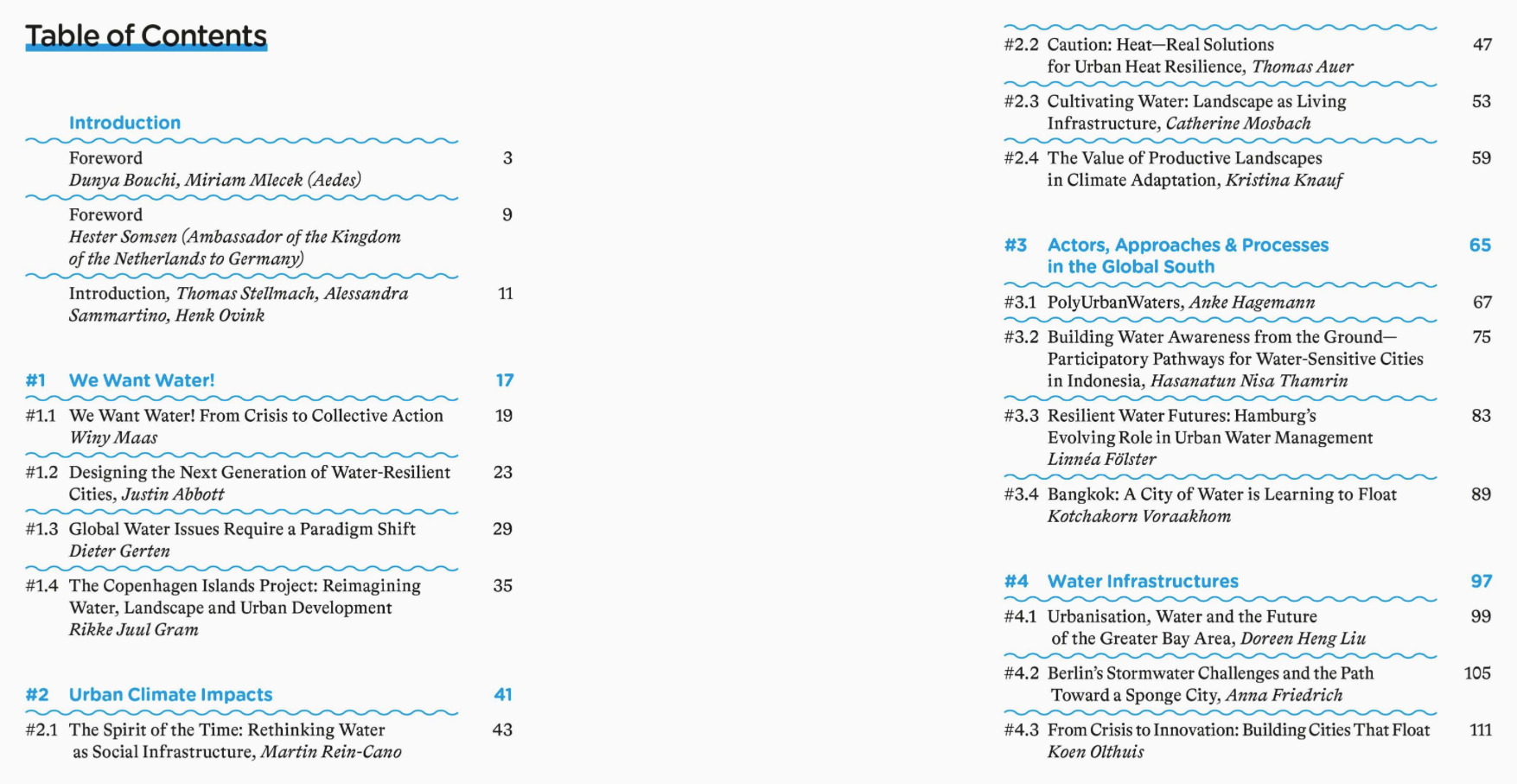
Distilling the series into 22 essays and a closing manifesto that translates the discussions into recommendations for action, this book offers a guide to a more resilient, water-wise future.
By treating water as both a critical value and a catalyst for trans-formation, the programme investigated how future cities can adapt to climate change while integrating innovative planning, governance and community engagement. Each talk highlighted urban, regional and global examples-from river deltas in China to European cities-showcasing future-oriented projects, pioneering typologies and water-sensitive approaches to planning and design. The topics covered in the series ranged from overarching questions about the importance of water for the planet to approaches taken by various actors and economic considerations, as well as tangible examples of infrastructure, landscaping, buildings and new materials.
This publication captures all the presentations of the six Lab Talks in 22 essays organised around focus themes.
At the back of the publication is a manifesto that translates the outcomes of the discussions into practical recommendations for action. The book thus serves both as a record of the series and as a guide for policymakers, architects and planners in applying its insights.
We are deeply grateful to the experts whose wide-ranging knowledge and insights have offered a remarkable diversity of perspectives on the topic of water.
BACKGROUND
Water affects every aspect of life, shaping both the natural and built environment. Too much or too little water impacts land-scapes, communities, infrastructure and economies alike. Water is both curse and blessing. This urgency inspired the six-part Aedes Lab Talk series Water: Curse or Blessing!? (2023–2025), bringing together architects, planners, scientists and policymakers to explore water as resource, element and infrastructure.
Today’s challenges are multi-layered. The water crisis intersects with climate change, biodiversity loss and socio-economic vulner-ability. We are witnessing unprecedented ocean heat, rising sea levels and extreme weather events across every continent. Groundwater levels are at historic lows, nearly half of the world’s lakes are shrinking, and billions of people still lack access to safe drinking water. Water scarcity and excess are also driving displacement: millions have already been forced from their homes by floods, storms, droughts and wildfires, with projections pointing to many millions more in the coming years and decades.
Knowledge to meet these challenges exists, but action remains too slow. Measures must now be taken to stabilise our global water system in the long term. Architects, planners and engineers can play a crucial role in translating understanding into practical solutions that embed ecological and social resilience-grounded in robust economic strategies—at the core of the built environment.
This new role can be a challenge but also an opportunity for actors from the building and planning sectors.
This urgency was the starting point for the six-part Aedes Lab Talk series Water: Curse or Blessing!?, held between November 2023 and June 2025.
WITH CONTRIBUTIONS BY:
- Justin Abbott, Europe Water Business Leader, Arup, Dublin
- Thomas Auer, Managing Partner, Transsolar, Stuttgart
- Dunya Bouchi and Miriam Mlecek, Aedes, Berlin
- Linnéa Folster, Infrastructure Development Unit, HAMBURG WASSER
- Anna Friedrich, Environmental Engineer, Rainwater Agency Berlin
- Dieter Gerten, Potsdam Institute for Climate Impact Research/Geography Department, Humboldt-Universität zu Berlin
- Rikke Juul Gram, Partner, Schønherr Landscape Architects, Copenhagen
- Anke Hagemann, Professor at Habitat Unit, TU Berlin
- Christian Kalytta, Senior Manager Product Development & Product Management, Cemex, Rüdersdorf
- Kristina Knauf, Senior Consultant, Arcadis, Amersfoort
- Doreen Heng Liu, Founder and Principal, NODE, Shenzhen/Director, GBA Lab, Shenzhen University
- Winy Maas, Director and Founding Partner, MVRDV, Rotterdam
- Catherine Mosbach, Founder, Mosbach Paysagistes, Paris
- Koen Olthuis, Architect and Founder, Waterstudio, Amsterdam
- Henk Ovink, Executive Director, Commissioner, Global Commission on the Economics of Water, New York
- Sandra Phlippen, Chief Economist, ABN AMRO Bank, Amsterdam/Groningen
- Martin Rein-Cano, Founder and Creative Director, TOPOTEK 1, Berlin
- Michelle Sanchez, Sustainability Lead, RSHP
- Hester Somsen, Ambassador of the Kindgom of the Netherlands to Germany, Berlin
- Thomas Stellmach and Alessandra Sammartino, TSPA Planning and Consulting, Berlin
- Hasanatun Nisa Thamrin, Programme Manager, Kota Kita, Surakarta
- Christian Veddeler, Partner, 3XN Architects, Amsterdam/Copenhagen
- Kotchakorn Voraakhom, CEO and Founder, Landprocess and Porous City Network, Bangkok
- Holger Wack, Deputy Head of Product Development Department, Fraunhofer Institute for Environmental, Safety and Energy Technology UMSICHT, Oberhausen
PUBLICATION DATA
Title: Water: Curse or Blessing!? Building a Future Planet
Publisher: Aedes Network Campus Berlin
Editors: Dunya Bouchi, Miriam Mlecek
Assistant Editor: Francesca Bani
Graphic Design: OfficeKB, Leipzig
Format: 190,8 x 196,8 mm, 160 pages
Language: English
ISBN: 978-3-944083-08-7
Price: 10 EUR
Publication Year: 2025
This project is supported by Deutsche Bundesstiftung Umwelt, Osnabrück; The Netherlands Ministry of Infrastructure and Water Management, The Hague; The OBEL Award, Copenhagen; Transsolar KlimaEngineering, Stuttgart; PolyUrbanWaters Research Project; GBA Lab, Shenzhen